
These Brazilian baked turnovers, or pastéis de forno, have a homemade butter pastry and a filling of tuna, red onion and cream cheese. Rest the pastry before shaping the turnovers into half-moons, then brush them with egg yolk and bake until golden.
Serve these tuna and red onion turnovers as a snack or light meal. A well-sealed edge keeps the savoury filling inside the pastry as it bakes.
Follow the steps below to prepare the filling, seal the edges and bake the turnovers until golden.
Ingredients for the pastry and filling
For the pastry
- 300 g plain flour
- 150 g cold unsalted butter, cubed
- 1 egg
- 1/2 teaspoon salt
- 3 to 5 tablespoons ice-cold water
- 1 egg yolk, for brushing the turnovers before baking
Ingredients for the tuna and red onion filling
- 1 tin of tuna in water or oil, about 170 g net weight, well drained
- 1 medium red onion, about 100 g, finely diced
- 1 tablespoon olive oil
- 2 tablespoons cream cheese, about 30 g
- 1 tablespoon chopped fresh parsley
- Black pepper to taste
Make the tuna and red onion filling

Drain the tuna well and let the filling cool before assembling the turnovers so it doesn’t make the pastry soggy.
- Drain the tuna: pass it through a sieve and gently press with a fork to remove excess liquid. Break apart the larger pieces, without turning the fish into a paste.
- Soften the onion: heat the olive oil in a frying pan over medium heat. Add the chopped red onion and stir for about 4 to 5 minutes until it becomes soft and slightly translucent, without browning too much.
- Stir in the drained tuna for 1 to 2 minutes, just until warmed through and evenly mixed with the onion. Turn off the heat.
- Stir in the cream cheese and parsley, then season with black pepper to taste. Let the filling cool completely. Hot filling can soften the pastry and make it hard to seal.
Roll out and cut the pastry
Use cold butter and handle the pastry as little as possible. It will be easier to roll once it has rested in the fridge.
- Mix the flour and salt in a bowl. Add the cubes of cold butter and rub them in with your fingertips until the mixture resembles crumbs, with a few small pieces of butter still visible.
- Form the pastry: add the egg and 3 tablespoons of ice-cold water. Mix with a fork and then with your hands, only until the pastry comes together. If it is still dry and crumbly, add the remaining water gradually, without exceeding 5 tablespoons; avoid kneading, so that the pastry does not become hard.
- Let the pastry rest: divide it into two parts, flatten each into a disc, and wrap. Place in the refrigerator for about 30 minutes, until it is firm but still pliable.
- Work with one piece of pastry at a time, keeping the other in the fridge. Roll it out on baking paper to about 3 to 4 mm thick. If it softens or sticks, chill it for a few minutes before continuing.
- Cut the circles: use a cutter or the edge of a bowl about 12 cm in diameter. Gather the trimmings without over-kneading, roll out again, and cut additional circles. Place them on the baking parchment and keep them chilled while preparing the other portion of the pastry.
Fill and seal the pastries
Keep the chilled filling to hand. Work with a few rounds of pastry at a time, leaving the rest in the fridge while you assemble the turnovers.
- Put about 1 level tablespoon of filling in the centre of each round without piling it up. Leave a clear border of about 1 cm all the way around so you can seal the turnover.
- Fold the pastry: lift one of the halves of the circle and cover the filling, aligning the edges to form a half-moon. If any piece of filling reaches the edge, remove it before closing, because it may interfere with the sealing.
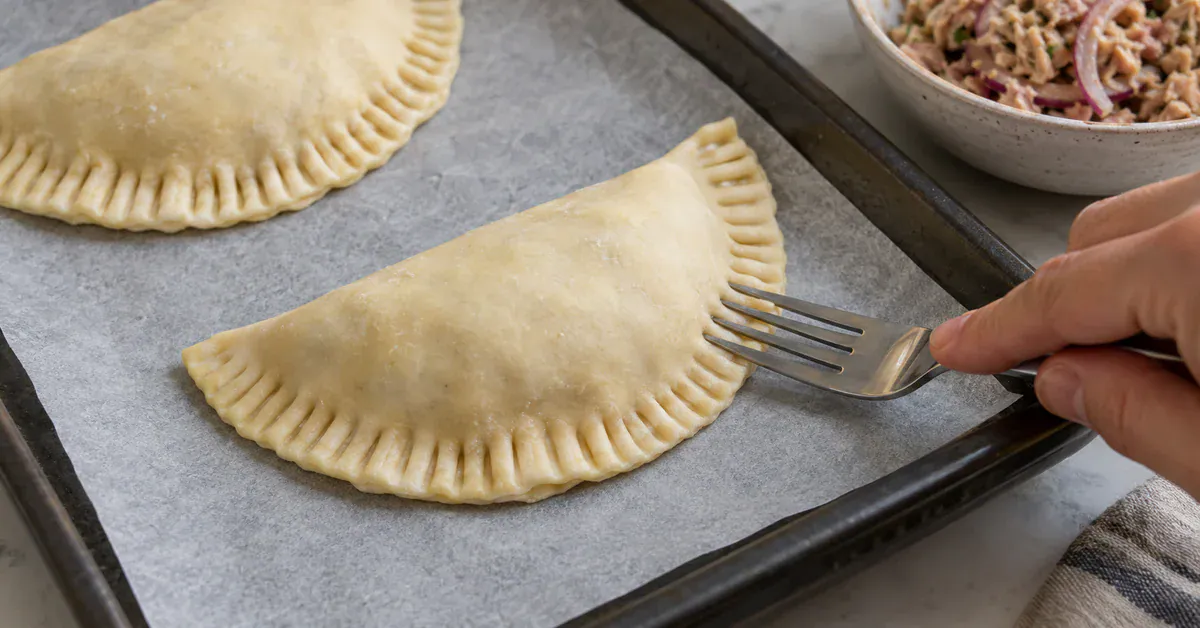
- Press the edges together with your fingers, gently pushing out air from around the filling. Crimp all the way around with the tines of a fork, taking care not to pierce the centre.
- Arrange the sealed turnovers on baking paper without overlapping them. If the pastry softens during assembly, chill the tray for a few minutes before brushing with egg yolk and baking.
Bake until the pastry is golden
- Preheat the oven to 200 °C. Meanwhile, keep the assembled turnovers spaced apart on the lined baking tray.
- Brush the tops lightly with egg yolk. Avoid letting it run down the edges, which can interfere with the seal.
- Bake on the middle shelf for about 20 to 25 minutes. Remove when the pastry is golden and firm to the touch. If it is still pale, bake for a few minutes longer, keeping an eye on the colour.
How to tell when the turnovers are ready and keep the filling inside

The turnovers are ready when the tops are golden and the pastry feels firm with no pale, damp patches. If you can check without breaking one, the base should be baked through rather than soft. Ovens vary, so check colour and texture as well as the suggested time.
A little filling may escape if the edge opens in the oven. Filling caught in the seam, a loose seal or a crack in the pastry can all cause this. Next time, keep the border clean and seal it all the way around. Avoid pressing a hot turnover closed.
If you see a small opening, let the turnover finish baking and take it out when golden and firm. Keep an eye on it through the oven door instead of repeatedly opening the oven. Leave the turnovers on the tray for a few minutes before moving them, as the freshly baked pastry is delicate.
How to serve and store the turnovers
Serve the pastries after a few minutes out of the oven, when the pastry is less delicate to handle. They can accompany a salad and work well as a snack or light meal.
If left over, wait for them to cool down and store them in a closed container in the refrigerator. To recover some of the crispness, warm them in the oven; the microwave tends to make the pastry softer.
Just before serving
Wait a few minutes before removing the pastries from the baking sheet; the freshly baked pastry is still delicate. Serve with a salad to complete the snack or light meal.
Questions about the recipe
Can I use oil-packed tuna in the filling?
Yes, the recipe accepts tuna in water or oil. Drain well before use to avoid excess moisture in the filling.
What if the pastry keeps breaking apart?
Add ice-cold water gradually until the pastry comes together, without exceeding 5 tablespoons in total. Mix only what is needed and avoid kneading, so that the pastry does not become hard.
How can I prevent the pastry from getting soft while shaping the pastries?
Work with a few discs at a time and keep the rest in the refrigerator. If the pastry softens, place the baking sheet in the refrigerator for a few minutes before brushing and baking.
Why might the filling escape during baking?
Filling caught in the seam, a loose seal or a crack in the pastry can cause a leak. Keep the border clear and seal it all the way around. If a turnover opens in the oven, let it finish baking and wait a few minutes before moving it.
How can I store leftovers and crisp them up again?
Wait for the pastries to cool down and store them in a closed container in the fridge. To reheat, prefer the oven; the microwave tends to leave the pastry softer.