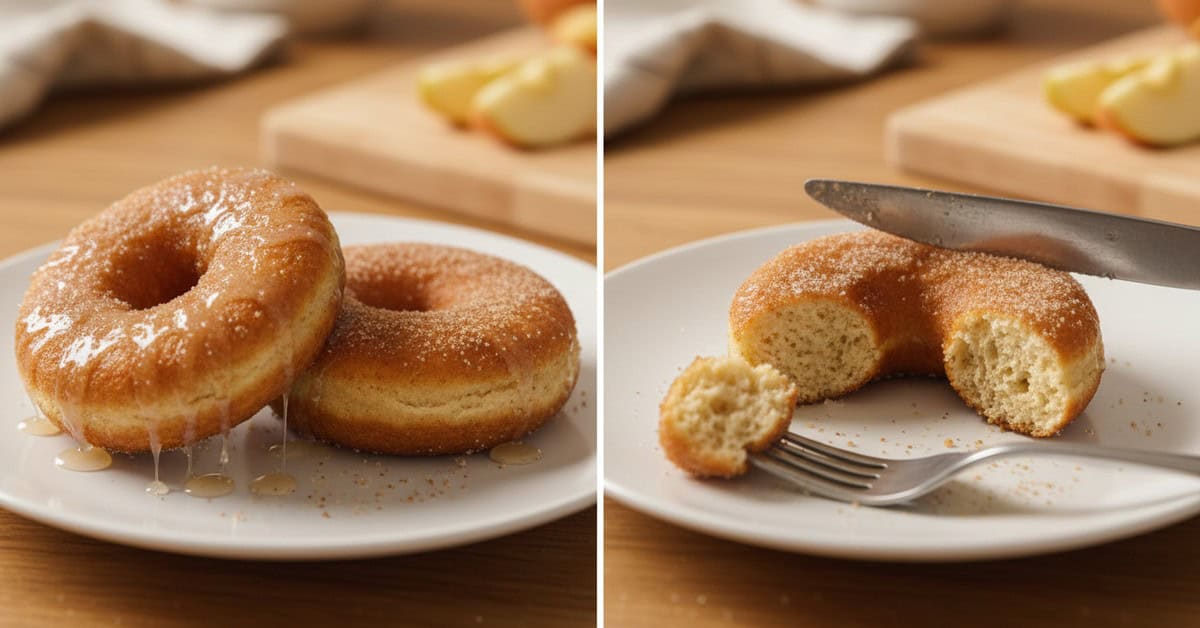

New England apple cider doughnuts get their apple flavor from reduced fresh cider and their warm spice from cinnamon and nutmeg. Fried until lightly crisp outside and tender in the middle, they are traditionally tossed in cinnamon sugar. You can also bake them or make a vegan batch.
Apple cider doughnuts taste like fall: fragrant dough, a hint of cinnamon and a sugary crust. Want to bring a New England orchard favorite home to share with friends? Here is the traditional recipe, with step-by-step directions and a few helpful shortcuts.
Ingredients for apple cider doughnuts
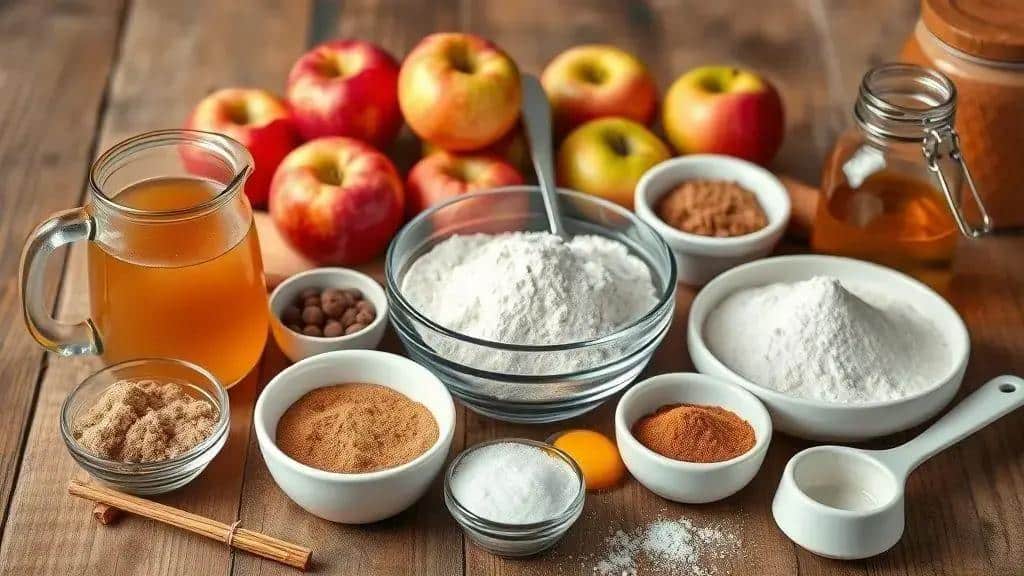
For traditional apple cider doughnuts, use fresh ingredients and measure carefully for the right flavor and texture.
- 240 g all-purpose flour (2 cups). A cup-for-cup gluten-free flour blend is an alternative.
- 100 g granulated sugar (½ cup) for the dough. Light brown sugar adds a deeper flavor.
- 50 g brown sugar (¼ cup) for extra depth, optional if you prefer a paler dough.
- 2 teaspoons baking powder for lift. Baking soda requires a different amount of acid and is not a direct substitute.
- ½ teaspoon baking soda for texture. Measure carefully to avoid a bitter taste.
- 1 teaspoon ground cinnamon, adjusted to taste, for the classic flavor.
- ¼ teaspoon grated nutmeg (optional) to bring out the apple aroma.
- ½ teaspoon salt to round out the flavors.
- 120 ml (½ cup) reduced apple cider. Simmer 240 ml fresh, nonalcoholic apple cider down to 120 ml for concentrated flavor. Reduced apple juice also works.
- 120 ml (½ cup) milk or buttermilk for a tender crumb. Use plant-based milk, or make a buttermilk-style substitute with ½ cup milk and 1 tablespoon vinegar.
- 1 large egg to bind the dough. For a vegan binder, mix 1 tablespoon ground flaxseed with 3 tablespoons water and let it gel.
- 45 g (3 tablespoons) melted butter for flavor and tenderness. Substitute neutral vegetable oil or melted coconut oil.
- About 1 liter vegetable oil for frying. Choose a high-smoke-point oil, such as canola or sunflower. To bake, grease the pan and use the baking times below.
- For the coating, mix 120 g granulated sugar with 1 teaspoon cinnamon and toss the warm doughnuts in it.
Substitutions and notes
If you do not have concentrated cider, simmer 240 ml fresh apple cider until reduced by half. Cool before adding it to the dough for a stronger apple flavor.
For vegan doughnuts, use the flax mixture in place of the egg, vegetable oil in place of butter, and plant-based milk. Fry as usual or bake at 350°F (180°C), checking after 10–12 minutes.
For baked doughnuts, shape the rings, brush with melted butter and bake in a preheated 350°F (180°C) oven for 10–14 minutes, turning halfway through.
How to make apple cider doughnuts, step by step

Follow the measurements and keep an eye on the temperatures for consistent homemade doughnuts.
- Reduce the cider: bring 240 ml apple cider to a boil over medium heat and simmer until about 120 ml remains. Let cool completely.
- Sift together 240 g flour, 2 teaspoons baking powder, ½ teaspoon baking soda, 1 teaspoon cinnamon, ¼ teaspoon nutmeg and ½ teaspoon salt. Mix well.
- In a separate bowl, beat 1 egg with 100 g granulated sugar and 50 g brown sugar until smooth. Mix in 120 ml milk or buttermilk, 120 ml reduced cider and 45 g melted butter.
- Pour the wet ingredients into the dry. Fold with a spatula just until the dough is evenly mixed and slightly sticky. Overmixing will toughen the doughnuts.
- If needed, cover and chill for 15–20 minutes so the dough is easier to handle. If it is already firm enough, roll it out.
- On a floured counter, roll the dough about 1.5 cm (⅝ inch) thick. Cut with a doughnut cutter and save the centers to fry as doughnut holes.
- Heat canola or sunflower oil in a deep pot to 175°C (about 350°F), checking with a frying thermometer. A small scrap of dough should bubble at once and brown in about 30 seconds.
- Fry in batches without crowding. Turn after 1–1½ minutes and cook the second side, about 2–3 minutes total, until evenly golden and cooked through.
- Lift out with a slotted spoon and drain for 1–2 minutes on a rack over paper towels. Keep the doughnuts warm enough for the coating to stick.
- Mix 120 g granulated sugar and 1 teaspoon cinnamon. Turn each warm doughnut in the mixture until evenly coated.
- To bake instead, arrange the doughnuts on a greased sheet and brush with melted butter. Bake at 350°F (180°C) for 10–14 minutes, turning halfway through, then coat in cinnamon sugar.
- Keep in an airtight container for up to 2 days. Refresh in the oven for 3–5 minutes to bring back some of the crust.
Practical tips
Fry 3–4 doughnuts at a time to keep the oil temperature steady, checking it with a thermometer to avoid greasy doughnuts. Try sweet paprika sugar, apple glaze or brown sugar for a different finish.
Frying tips for the right texture
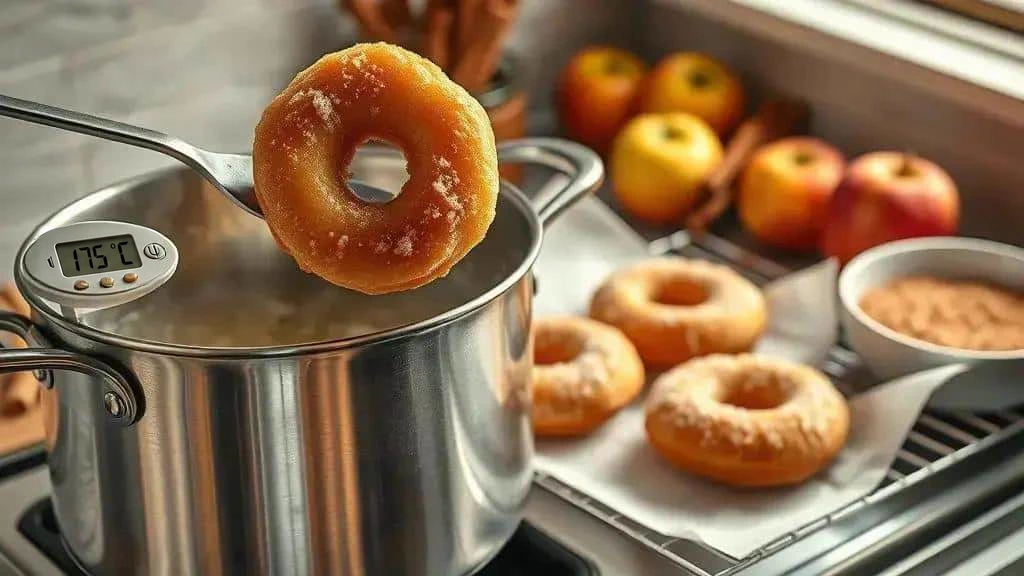
Heat, timing and gentle handling make the difference between crisp, tender doughnuts and tough or greasy ones.
Oil temperature
Use a frying thermometer to keep the oil at 170–180°C (338–356°F). Too hot and the outside burns before the center cooks. Too cool and the doughnuts absorb excess oil.
Frying, step by step
- Pour enough oil into a deep pot to submerge the doughnuts, about 3–5 cm (1¼–2 inches), and heat to 170–180°C (338–356°F).
- Drop in a small scrap of dough. It should bubble and turn golden in about 30 seconds.
- Fry in batches of 3–4 so the oil temperature does not drop sharply.
- Turn just once. Fry for 1–1½ minutes on the first side and another 1–1½ minutes on the second, until golden and cooked through.
- Use a slotted spoon and tongs to turn the doughnuts gently and minimize splashing.
How to keep doughnuts from getting greasy
Leave room in the pot and keep the oil temperature steady. Move the cooked, golden doughnuts to a rack. Paper towels underneath will catch the oil, but leaving the doughnuts directly on the paper traps steam and softens the bottoms.
Coating and finishing
Mix the cinnamon sugar before frying. Toss the doughnuts while they are still warm so the coating sticks. For a glaze, let the doughnuts cool a little first so it stays on the surface.
Storage and reheating
Store airtight for up to 2 days with parchment between layers. Warm at 150°C (300°F) for 3–5 minutes to restore some crispness. Microwaving softens the crust.
Quick kitchen tips
- Buttermilk keeps the crumb tender, and reduced cider concentrates the apple flavor.
- For consistent results in large batches, monitor the oil with a thermometer.
- Canola and sunflower oil both have a high smoke point and work well for frying.
Apple cider doughnut variations: baked, vegan and glazed
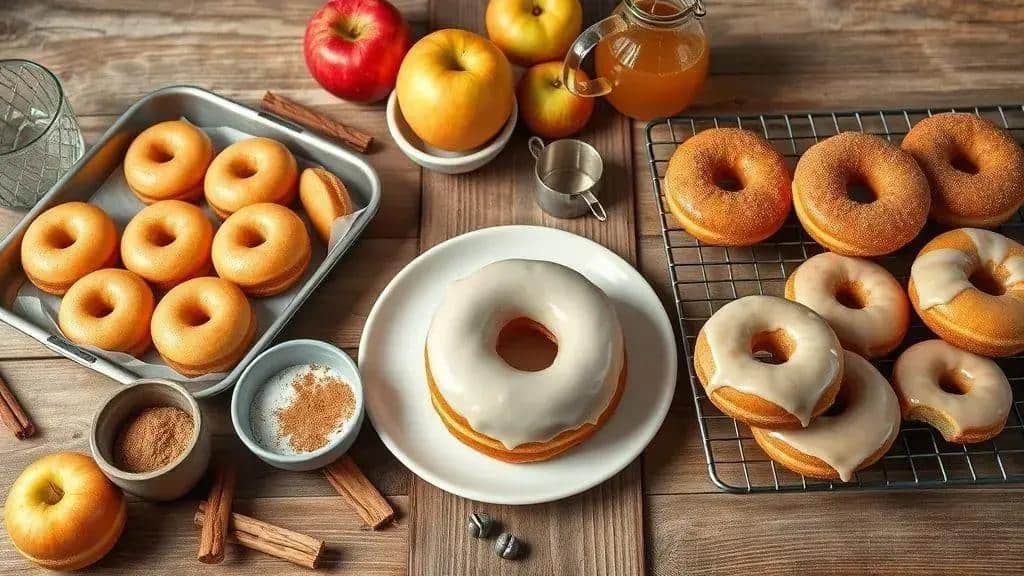
Adjust the texture, ingredients or finish with these variations.
Baking instead of frying
The baked version is lighter and convenient for larger batches. Use the basic dough and adjust the liquid slightly for your pan.
- 240 g (2 cups) all-purpose flour. Replace up to 30% with whole wheat flour if desired.
- 100 g sugar. Use a little less for a less sweet doughnut.
- 2 teaspoons baking powder.
- 120 ml reduced apple cider for a concentrated flavor.
- 120 ml milk, or use plant-based milk.
- 1 egg, or 1 tablespoon ground flaxseed mixed with 3 tablespoons water.
- 45 g melted butter or vegetable oil.
- Preheat the oven to 350°F (180°C). Grease a doughnut pan or use a silicone pan.
- Sift the flour, baking powder, cinnamon and salt into a bowl.
- Whisk the sugar, egg, milk, reduced cider and butter until smooth.
- Fold the dry ingredients into the wet with a spatula, just until combined.
- Fill each doughnut cavity three-quarters full to leave room for the batter to rise.
- Bake for 10–14 minutes, until golden and a toothpick inserted into the crumb comes out clean.
- Remove from the pan, wait 2 minutes and roll in cinnamon sugar.
Vegan version
A few plant-based swaps and a flax binder keep the doughnuts tender and full of apple flavor.
- 240 g all-purpose flour.
- 100 g brown sugar.
- 2 teaspoons baking powder.
- 120 ml reduced apple cider.
- 120 ml oat or almond milk.
- 1 tablespoon ground flaxseed and 3 tablespoons water. Let stand for 5 minutes to gel, replacing 1 egg.
- 45 g vegetable oil in place of butter.
- Make the flax “egg” by stirring the ground flaxseed into the water and letting it gel.
- Mix the flour, baking powder, cinnamon, nutmeg and salt.
- Combine the sugar, plant-based milk, reduced cider, oil and flax mixture.
- Fold the wet and dry mixtures together lightly. The dough should be slightly sticky.
- Fry at 170–175°C (338–347°F), or bake at 350°F (180°C) for 12–14 minutes, following the chosen method.
Toppings and flavor variations
- Cinnamon sugar: combine 120 g sugar and 1 teaspoon cinnamon, then coat the warm doughnuts.
- Maple glaze: combine 120 g confectioners’ sugar, 2–3 tablespoons maple syrup and 1 tablespoon milk or plant-based milk.
- Apple glaze: reduce 60 ml cider to 30 ml, mix with 80 g confectioners’ sugar and spread over cooled doughnuts.
- Salted caramel: use ready-made caramel or make a quick version with brown sugar, butter or vegan margarine, and a pinch of salt. Apply while warm.
- For crunch, glaze the doughnuts and scatter with sprinkles, chopped nuts or toasted oats.
Practical tips
- The topping adds sweetness of its own. Use less sugar in the dough if you plan on a thick glaze.
- A looser batter makes softer doughnuts. A firmer dough gives a denser crumb.
- Store airtight for up to 2 days. Warm in a 150°C (300°F) oven for 3–5 minutes before serving.
The story behind New England apple cider doughnuts
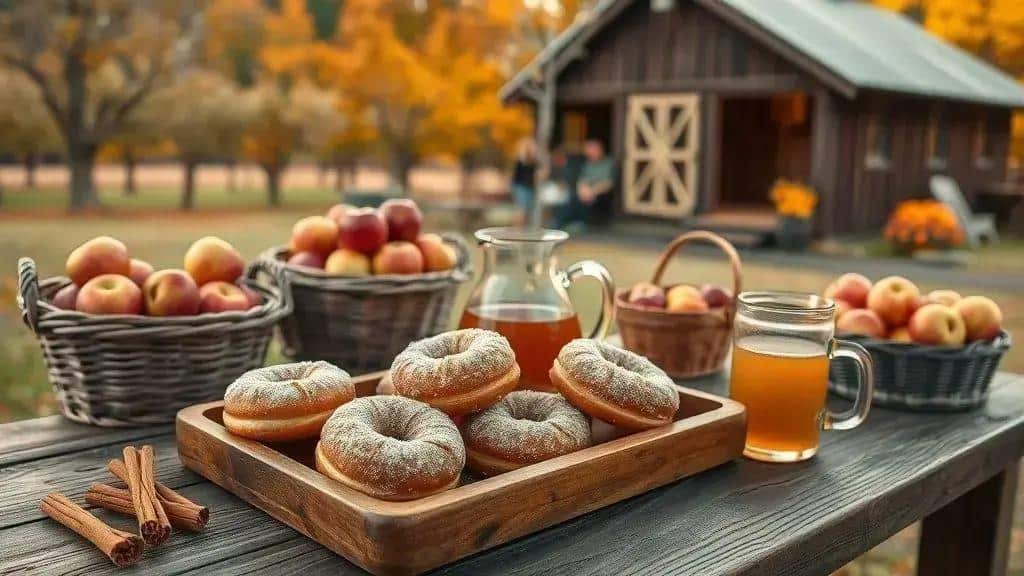
Cider doughnuts have become an orchard tradition in New England, where visitors enjoy fresh-pressed cider and warm doughnuts during the fall harvest.
Origins and regional history
By the 19th century, cider and doughnuts were served together in the Northeastern United States. In 1951, the Doughnut Corporation of America announced a commercial mix that put cider into the dough itself. Today those doughnuts are a familiar part of orchard season.
A fall tradition
For many people, fall means a trip to an orchard, picking apples and warming up with hot cider and a doughnut. Fairs and cider mills draw crowds for weekend events and fresh batches.
A few quick facts
- Many recipes reduce the cider before mixing it into the dough to concentrate the apple flavor.
- The classic doughnut has a lightly crisp crust and a tender middle, a different texture from many mass-produced doughnuts.
- Massachusetts and Vermont are particularly associated with the cider doughnut tradition.
- Alongside cinnamon sugar, maple and apple glazes have become popular finishes.
- Doughnut sales give small apple growers another source of income during the fall harvest.
How they spread
As farm tourism grew and shoppers sought local products, cider doughnuts moved from orchards into town markets and cafés. Bakers developed oven-baked and vegan versions as well as local flavor variations.
A closer look at the ingredients
Tart apples give reduced cider a brighter flavor, while sweeter varieties give it a softer profile. Buttermilk and regular milk also produce slightly different crumbs.
Conclusion
Thanks for making apple cider doughnuts with us. We hope these tips help you get just the flavor and texture you want at home.
Follow us on social media for more easy recipes and baking tips, and visit the Mestre das Receitas blog for more ideas and inspiration.
Share your photos and tell us how your batch turned out. We love seeing your versions. Until next time!
Frequently asked questions about apple cider doughnuts
What is the best oil temperature for frying apple cider doughnuts?
Keep the oil between 170 and 180°C (338–356°F) so the outside browns and the center cooks without absorbing too much oil.
How do I keep my doughnuts from getting greasy?
Fry in small batches at a steady temperature and drain briefly on a rack over paper towels so steam can escape from the bottoms.
Can I bake them instead? How should I adjust the recipe?
Yes. Slightly adjust the liquid in the basic dough, fill a doughnut pan and bake at 350°F (180°C) for 10–14 minutes. Coat in cinnamon sugar while still warm.
How can I make vegan doughnuts?
Replace the egg with a gel made from 1 tablespoon ground flaxseed and 3 tablespoons water. Use vegetable oil instead of butter and plant-based milk in place of dairy milk, then fry or bake as usual.
What is reduced cider, and why use it?
Simmering cider until half its original volume concentrates the apple flavor. The reduction gives the doughnuts a more pronounced apple taste and aroma.