

The baked Brazilian pasty with eggplant and dry tomato features a soft filling, cooked until no liquid remains at the bottom of the frying pan. The discs are folded in half into a half-moon shape, closed with a fork, and brushed with egg before baking until golden.
The baked Brazilian pasty with eggplant and dry tomato features a prominent vegetable filling in a roasted dough, a practical option to serve as a snack or light meal. The preparation demonstrates how to cook the eggplant with the dry tomato and assemble the pastries, with attention to closing the dough so that the filling is well-contained before baking.
Ingredients and quantities
The quantities yield approximately 8 baked Brazilian pasties, using dough disks about 12 cm in diameter.
For the filling
- 1 medium eggplant (about 300 g), cut into small cubes
- 1⁄2 medium onion, chopped
- 1 garlic clove, finely chopped
- 80 g of dry tomato in canned form, drained and chopped
- 1 tablespoon (15 ml) olive oil
- ½ teaspoon salt
- Black pepper to taste
For assembly and brushing
- 8 ready-made baked pasty dough disks, about 12 cm in diameter
- 1 egg
- 1 tablespoon water
Prepare the eggplant and dry tomato
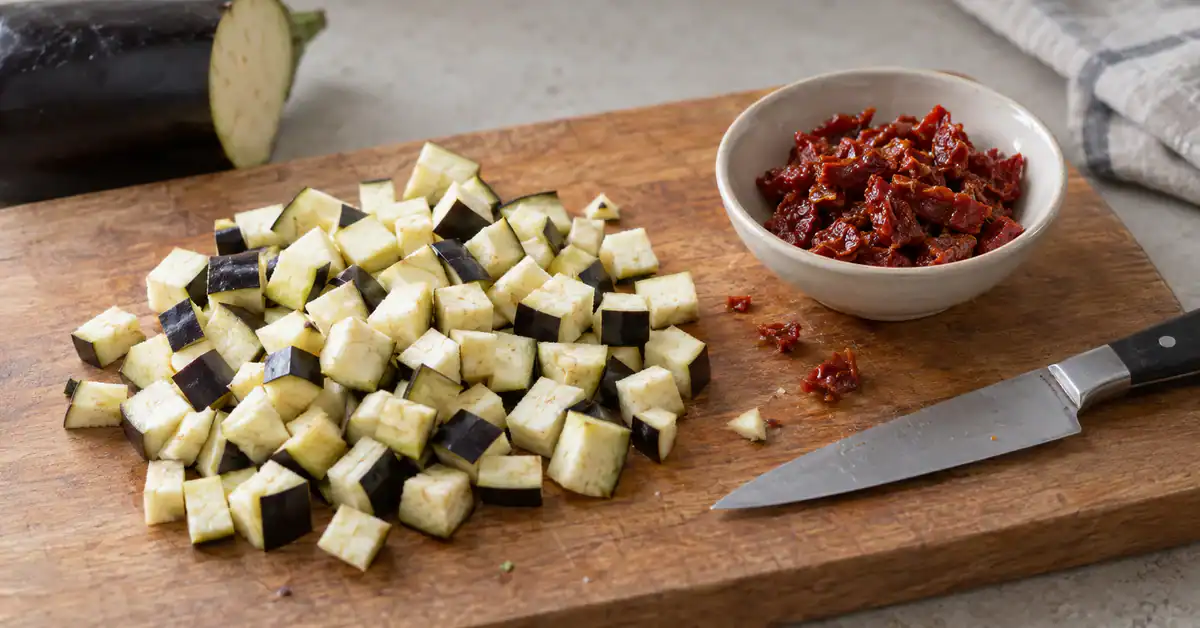
- Prepare a eggplant: wash and dry the eggplant, trim the ends, then cut into small cubes, about 1 cm in size. Keep the pieces separate to cook later; it is not necessary to soak them.
- Pierce the dried tomato: drain well the 80 g of dried tomato in jar and cut into small pieces. Keep it separate from eggplant until the filling cooking stage.
Cook the filling until it is soft
- Sauté the onion and garlic: heat the olive oil in a medium frying pan over medium heat. Add the onion and stir for about 3 minutes until it starts to become transparent; add the garlic and stir for another 30 seconds, without browning it too much.
- Cook the eggplant: add the cubes to the frying pan, season with salt and black pepper, and mix. Reduce the heat to medium-low, cover, and cook for about 8 to 12 minutes, stirring every few minutes so the pieces cook evenly.
- Add the dried tomato: when the eggplant is soft, add the chopped tomato and cook for another 2 minutes, stirring to distribute the pieces throughout the filling.
How to check the eggplant texture
Stick a cube with a fork: it should yield easily but still retain its shape, without turning into puree. If it is firm in the center, cover again and cook for a few more minutes on low heat, checking occasionally. The filling is ready when the eggplant is soft and there is no accumulated liquid at the bottom of the frying pan.
Cool the filling before assembling
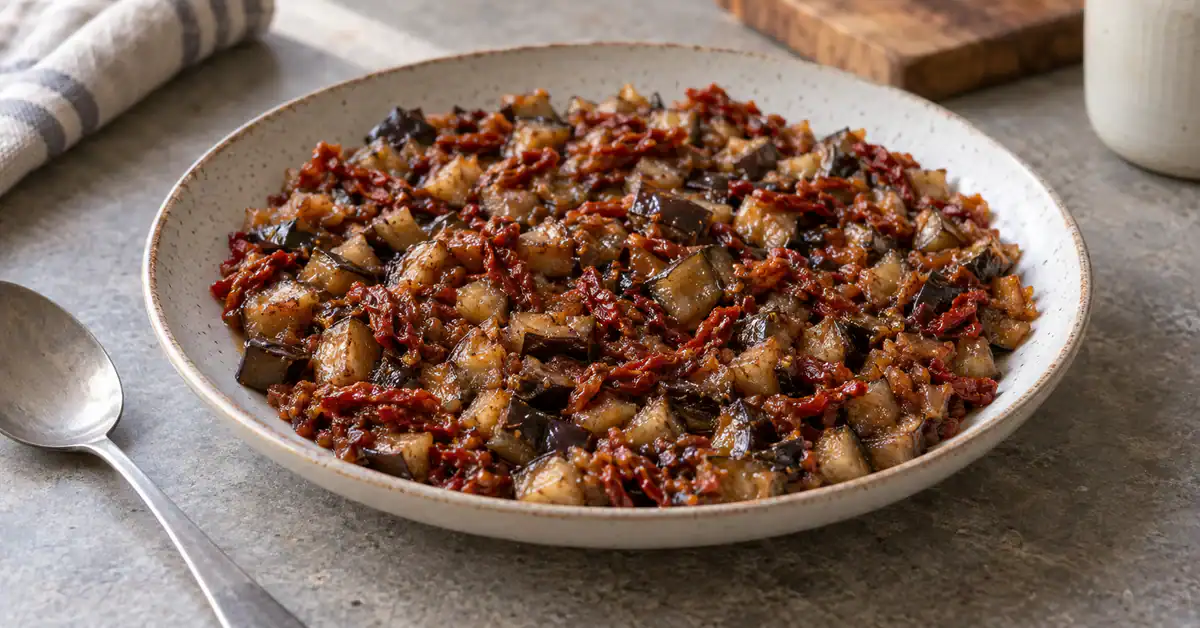
Spread the stuffing into a large dish or shallow container, using a spoon to form a thin layer. Thus, it loses heat more evenly than if it stayed in the frying pan.
Let cool until it reaches room temperature and no longer releases steam. Avoid assembling the pastries while the filling is still hot: heat can soften the dough and make closing difficult. When it is cold, it will be ready to be distributed on the discs.
Fill and shape the turnovers
- Distribute the filling: place the 8 disks of dough on a clean and dry surface. Divide the already chilled filling between them, placing each portion in the center and leaving a free strip around; this way, the filling does not interfere with the closure.
- Shape the pastries: fold each disk in half to form a half-moon, and align the edges without pressing them yet. Keep the filling centered, without piling it next to the fold; in the next step, the edges will be sealed to prevent the filling from escaping during baking.
Seal the edges to hold the filling in place

With each disk folded into a half-moon, press the edges with your fingers to join the dough, starting near the center and working to the ends. Apply even pressure without pushing the filling outward.
Then pass the teeth of a fork along the edge to reinforce the closing. If the dough starts to tear, stop pressing at that point and adjust carefully; also check if there is no filling trapped between the edges, as this can leave an opening during baking. Arrange the closed pastries on a baking sheet, ready to brush and bake.
Bake until golden, then serve
- Preheat the oven to 200 °C. Meanwhile, place the closed pastries on the baking sheet, leaving a small space between them.
- Brush and bake: beat the egg with water using a fork and spread a thin layer over the top of the pastries. Bake in the oven for about 20 to 25 minutes, until the dough is golden; as ovens vary, start checking the color near the end of the time.
- Serve: remove the baking sheet from the oven and let it sit for a few minutes before bringing the pastries to the table. The filling will be very hot shortly after baking.
Serve still warm
When the dough is golden, remove the pastries from the oven and let them rest for a few minutes before serving, as the filling will be very hot. Serve them as a snack or light meal.
Questions about the recipe
How do I know the filling is ready to assemble?
Check if the eggplant yields easily when pierced with a fork, but still retains its shape. There should also be no accumulated liquid at the bottom of the frying pan.
What if the aubergine is still firm?
Cover the frying pan and cook for a few more minutes on low heat, checking from time to time. Add the dry tomato when the cubes are tender.
Why do I need to wait for the filling to cool down?
Wait until it reaches room temperature and stops releasing steam. If it’s hot, it can soften the dough and make it difficult to close the pastries.
How can I prevent the filling from escaping during baking?
Leave a border free on the edges and check if any filling is stuck between them. Press the dough to seal the edges and use the tines of a fork to reinforce the closure.
When can I remove the pastries from the oven?
Remove them when the dough is golden; at 200 °C, this usually takes 20 to 25 minutes. Wait a few minutes before serving, as the filling will be very hot.